Impact test, especially the Charpy V-notch test, is a commonly employed technique for assessing a crucial mechanical property of materials: their capacity to absorb energy during impact, referred to as impact toughness.
In the domains of mechanical engineering, steel frameworks, and industrial systems including stacks, pipelines, and pressure vessels, assessing this metric is crucial for maintaining operational safety.

The outcomes of impact testing precisely demonstrate how materials respond under extreme conditions, including high winds, vibrations, shock loads, or low temperatures—situations that numerous real-world steel structures encounter and must endure to prevent sudden failure.
Why is it essential for steel?

Under typical conditions, steel exhibits a crystal structure mainly consisting of ferrite and pearlite phases, which enables considerable plastic deformation prior to fracture. However, when the temperature falls below a specific threshold, the movement of dislocations within the crystal lattice becomes limited, resulting in the material losing its ability to deform plastically and instead experiencing abrupt brittle fracture.
This phenomenon is referred to as the ductile-to-brittle transition. The temperature at which the failure mechanism shifts from ductile to brittle is known as the Ductile-to-Brittle Transition Temperature (DBTT). This transition is one of the factors contributing to significant failures in structural and pressure engineering.
When traversing this region, the impact energy diminishes significantly, resulting in a fracture that is flat and shiny – indicative of brittle fracture. Consequently, if this characteristic is not managed, a structure that operates normally in warm conditions can suddenly fracture when exposed to cold air or low-temperature environments, without any preceding signs of deformation.
Applications of impact testing in assessing steel materials.
Ensuring the security of outdoor structures.
Stacking systems, industrial chimneys, welding equipment, support structures, and similar components are consistently exposed to strong winds, vibrations, and fluctuations in temperature, particularly during nighttime or in colder seasons. Impact testing is essential to verify that the steel maintains its integrity and does not become brittle under these challenging conditions.
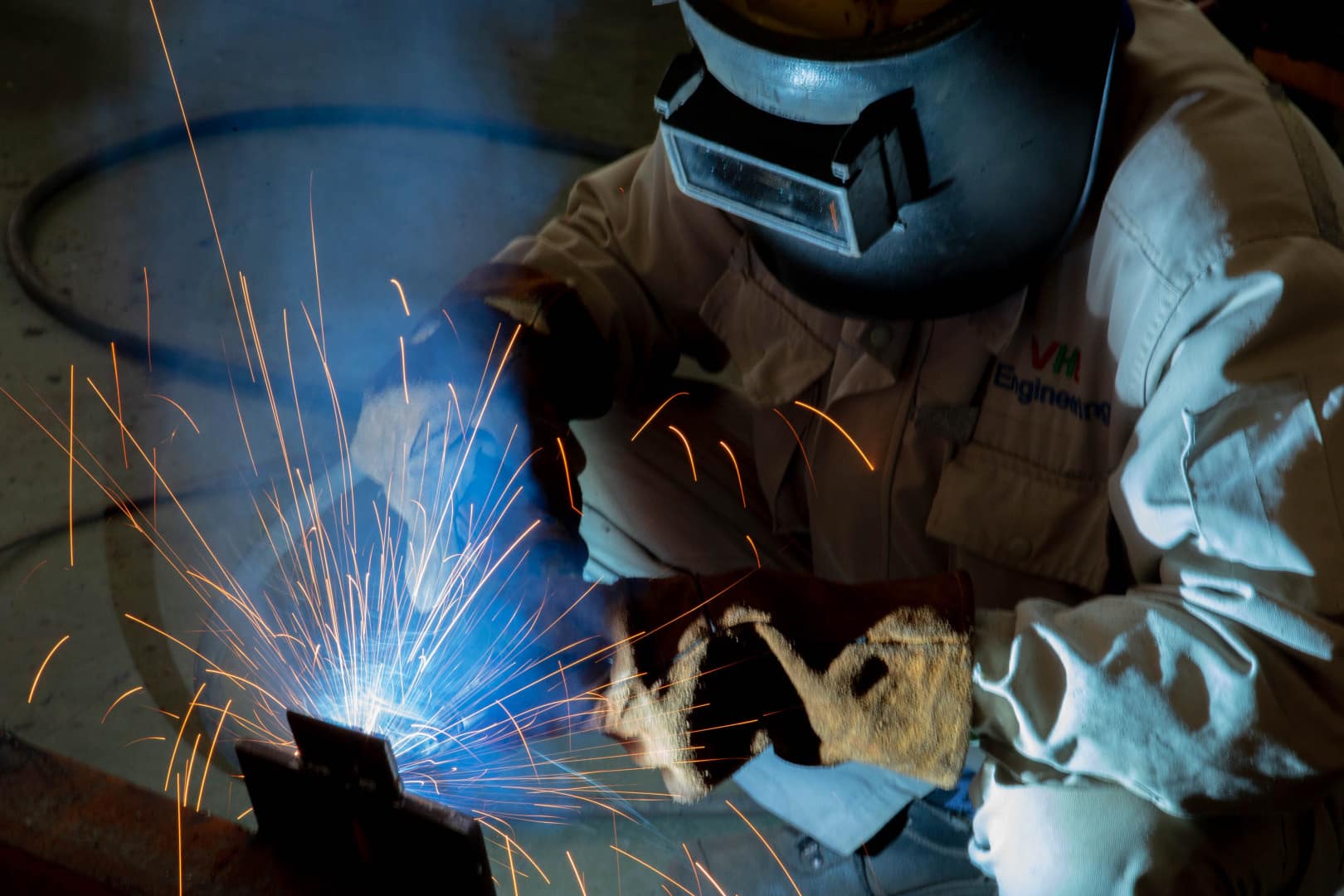
Avoid brittle fracture in welds and stress areas.
As the temperature drops, the Heat Affected Zone (HAZ) of the weld exhibits increased brittleness compared to the surrounding steel, making areas of concentrated load potential fracture points. Testing is essential to assess whether the steel possesses adequate impact toughness to withstand brittle fracture during operation.
Complies with international standards.
The standards set by the EU and the USA explicitly outline the requirements for impact testing.
- S235JR: 27 J at 20°C
- S235J0: 27 J at 0 degrees Celsius
- S235J2: 27 J at –20°C
- ASTM A516 Grade 70: Evaluated at –20°C
- ASTM A36: Impact testing is not required unless specified by the client.
These values indicate the operational capacity of steel at various temperatures, particularly in cold conditions or under dynamic loads. Consequently, when designing components such as welding necks, stack bodies, or plates that experience dynamic loads, the selection of materials should be informed by the minimum design metal temperature (MDMT) and the associated impact energy value.
Neglecting to conduct impact testing in these situations results in disregarding a possible failure mechanism, which has, in practice, led to numerous unforeseen brittle fractures at welds or areas of stress concentration.

Impact testing – A crucial safety evaluation instrument.
Impact testing is an essential technique for evaluating the capacity of steel to withstand brittle fracture in challenging environments, including low temperatures, high winds, vibrations, or shock loads. The results of the test indicate the amount of energy the material can absorb prior to fracturing, enabling VHE to evaluate the fracture risk in critical regions such as welds or areas of stress concentration.
This information is crucial for assessing whether a material meets its minimum operating temperature (MDMT) requirements. Due to its capability to predict the risk of brittle fracture, impact testing has become a necessary inspection procedure to guarantee the safe and stable functioning of steel structures during their operational lifespan.